
Local Food Brings Coffee Local Food Brings CoffeeTalks Together
A Bit About Michael
In the early 1970s, Michael (Mike) Hursey bought a copy of Organic Gardening that sparked his curiosity about how food is grown and how chemicals affect soil and human health. This idea stuck with him, and in the 1990s Hursey enrolled in culinary classes at Johnson County Community College, then found himself traveling to Italy to study cooking. There, he experienced firsthand how food brings people together and was introduced to the Slow Food movement. That experience reshaped his direction, showing him that food could be a powerful connector across cultures and communities.
After retiring, Hursey devoted himself fully to the local food movement. He helped start the Kansas City Slow Food chapter, connected farmers, chefs, and eaters, and transformed his own on-farm bed and breakfast, Casa Somerset into a community hub for food-centered gatherings. His work has expanded to include regenerative agriculture, agritourism, and the development of a regional elderberry network to strengthen local food systems.
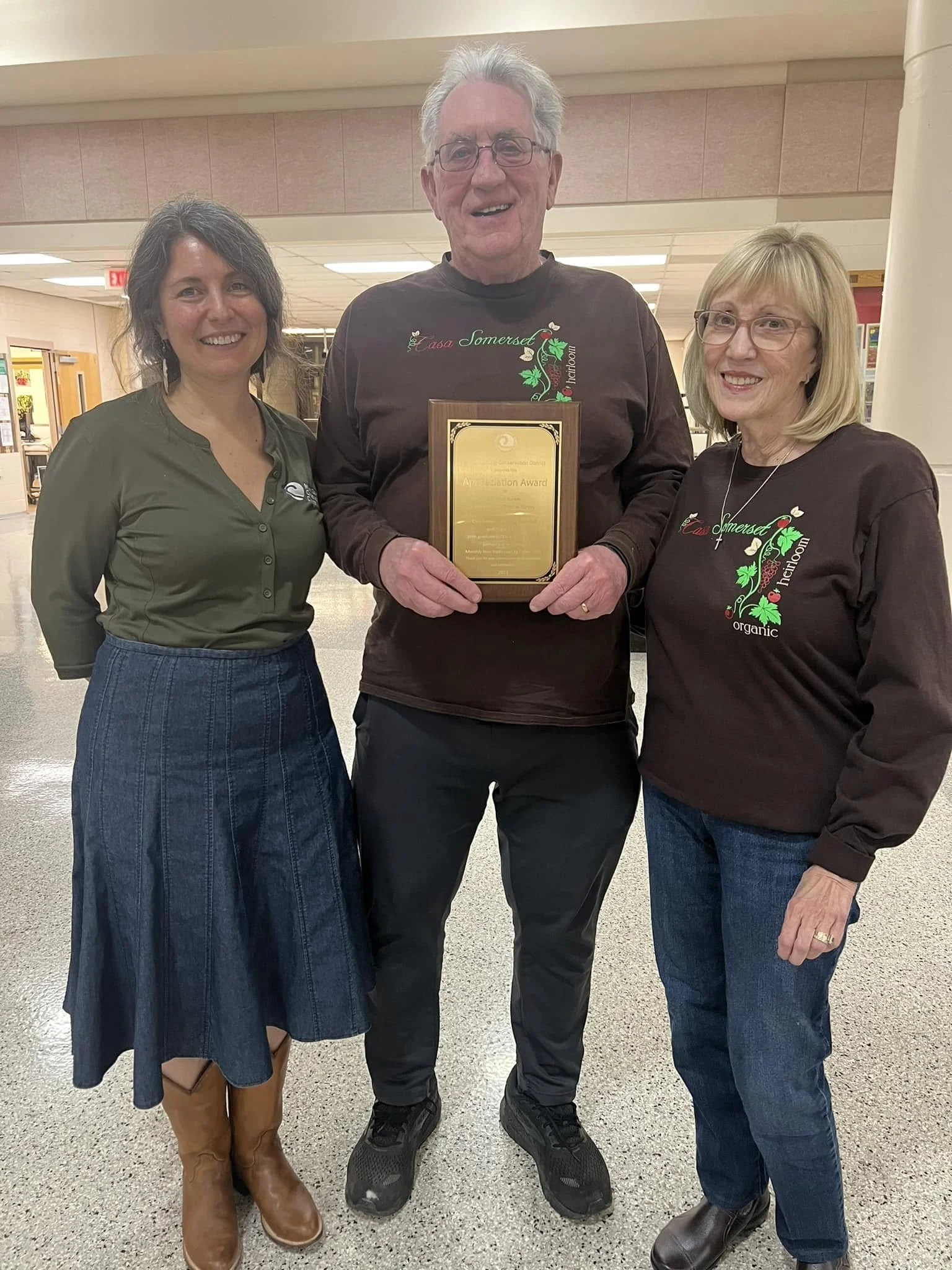
Pictured here is Sharon Autry with Mike and Christine Hursey who were presented with the Partnership Appreciation Award on behalf of Miami County Conservation District for their commitment and contribution toward building the Farmer to Farmer Coffee Talks.
Hursey’s passion for education and outreach showed up everywhere, from serving as a demonstration chef at the Overland Park Farmers Market, where he offered samples and simple recipes to introduce shoppers to local foods, to using social media to amplify food events across the region. He found that tasting food or seeing a chef buy directly from a farmer often turned curiosity into long-term support for local producers.
A Bit About Sharon
Sharon Autry is farmer and steward of Herdsman House Farm, a small specialty crop operation on the greater Historic Martin Farm, near Hillsdale Lake in Miami County
She is the Urban Ag Specialist for Miami County Conservation District where she supports urban and small-scale producers by facilitating access to education, technical assistance and funding resources.
Autry has served as Farm Director at KC Farm School, an urban training farm in Wyandotte County, and has served in leadership roles with KC Young Farmers Coalition. She also gained experience with local food distribution through her involvement with the KC Food Hub, Rolling Prairie Farmers Alliance CSA, and Louisburg’s Nomad Market KC.
She is passionate about building a collaborative community among farmers, food businesses and consumers in a way that bolsters the local food system and ensures consistent and equitable access to healthy food.
How the Coffee Talks Began
In 2022, Sharon Autry attended regional focus groups for small- and mid-scale producers. These groups were made possible by K-State, KACD, and partnering Conservation Districts. Again and again, producers voiced the same need: they wanted time to connect, share knowledge, and learn from one another through conversation — not lectures.
Using KACD funding, Autry acted on what she heard. She designed a monthly gathering centered on soil health, food systems, and producer-driven topics, and partnered with Hursey to host the meetings at Casa Somerset. Neither expected large crowds, but both recognized the unmet need for community.
From the beginning, the Non Traditional Ag Farmer to Farmer Coffee Talks were structured as discussions, not presentations. Meetings open with introductions: who participants are, what they do, and where they’re located. This helps people quickly see shared interests and opportunities for collaboration. Topics are shaped by producer input, guided initially by focus group results and later by conversations that emerge each month.
Farmers often lead discussions, with guest experts brought in when needed. Sharing breakfast together sets a welcoming tone and reinforces the idea that everyone in the room is a resource.
Consistency has been key. The Coffee Talks happen every third Thursday, with clear communication before and after each meeting, including follow-up emails sharing resources and contacts.
A Growing, Replicable Model
Autry promoted the Coffee Talks broadly, inviting rural and urban producers across her service area. What began with fewer than 20 participants now regularly draws 25–30 people, with some meetings reaching 40 or more and representing over 13 counties in Kansas and Missouri.
“Farming presents so many challenges, regardless of whether an operation is large or small-scale, urban or rural.” Autry says, “Working in community offers folks greater access to peer-to-peer education, resource sharing and social support which are all integral to supporting the resiliency of the farm and the farmer and ultimately the availability of local food.”
People attend for both information and connection. The Coffee Talks break down silos, reduce duplication of effort, and help participants see one another as collaborators rather than competitors. Both Autry and Hursey emphasize that the model isn’t meant to be copied exactly. Each community must shape its own version based on local needs. The key is listening first, creating a consistent and welcoming space, and letting food and conversation do the rest.
Together, their work shows that when you have the power of local food and pair it with intentional listening and community leadership, people come to support their food system, one cup of coffee at a time.