
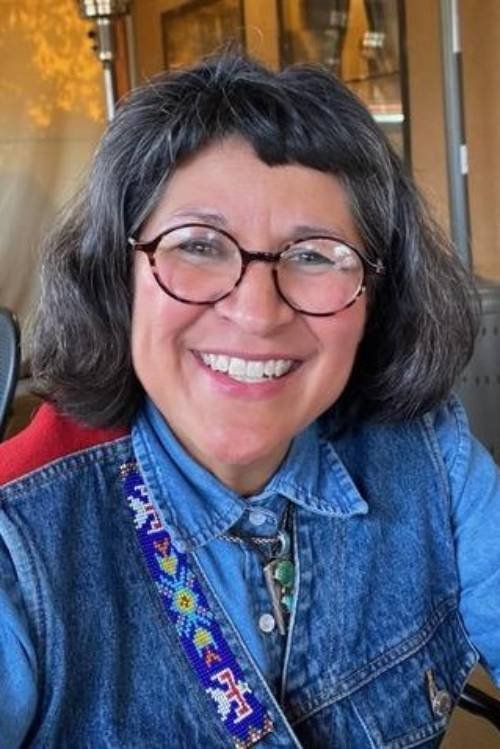
Dr. Debra Bolton
My name is Debra J. H. Bolton, my good friend, Jackie Keller, introduced me to the Kansas Rural Center. I come from the Ohkay Owingeh/Diné Peoples, Matrilineally and from the Uncompahgre (Ute), Patri lineally of the “American” Southwest. We are a farming People, raising sheep and large gardens and hunting elk and venison. Colonization changed that as we were increasingly dispossessed from our lands in favor of the concept of settler ownership codified in the Homestead Act of 1862.
The land means everything to us, because our lives depended on the land, and we would have never monetized the land since we believe that it is a living relative, and one does not monetize a relative. My parents lived by that and taught us to honor the land through stewardship and care for seven generations in the future.
While I am more than my occupation, my work is closely tied to my belief that we are here to care for the earth, for one another, and we are to remain curious about planet earth, including all human and non-human relatives. My Dad taught us never to lose our curiosity and wonder, and to be interested in everyone we meet.
I teach climate science and geography at Haskell Indian Nations University. Also, I am on an National Science Foundation (NSF) grant in which we address coastal climate erosions of four regions of large Indigenous populations: Alaska, Hawai’i, Louisiana, and Puerto Rico. These populations are contributing the least to the earthly extractions that exacerbate climate change, but are the most impacted, because they happen to live in places with the most natural gifts, of which capitalism is eager to take. I continue to be part of an NSF grant at K-State, too. I’m studying how drought disproportionately affects agricultural workers in SW Kansas.
I grew up in the mountains of Western Colorado. Our lives centered on camping, skiing, fishing, hiking, star gazing, and just being outside. My favorite activity was foraging. We learned the names of plants, roots, fruits, berries, seeds, and other animals that contributed to our delicious diets. My deep appreciation of the natural world in a mountain zone prepared me to move to the prairies of Kansas where I found the skies to be on a wider display without mountains to hinder the view. I am equally at home in the mountains and on the vast prairies of the central high plains.
I find food system work, like what Kansas Rural Center is involved in, interesting. When people are taken away from their food systems, as my ancestors were, and they are left with heavily processed foods, as is/was the case with commodities and similar food rations, a once healthy people gave way to poor health and disease. When we compare ourselves with fresh food systems, such as Italy and its healthy way of eating, we can acknowledge and understand why the overly processed food systems of the U.S. leave its people ailing. My people lived on a diet of fresh foods and well-preserved (without extensive processing) foods, contributing to optimal health and well-being. Try to imagine being taken away from your food system.
Wanting to be a good steward of the land does not always align with capitalistic endeavors. I continue to be involved in addressing the sound stewardship of the natural world. That will never change for me. My mother is 96 years old. She’s healthy because she has stayed away from overly processed foods. I follow her lead on that. Mom’s dad, my grandpa, died one week before his 100th birthday. He lived a healthy life. If we are living longer, we must eat healthfully. Attitude has a lot to do with optimal health, too. I love to cook and bake, so I think that contributes to optimal health, too.